


You might never have thought about whether water is hard or soft, but the difference is real, and if you don’t know which your water source provides, it can mess with your feed. Growers will spend all day thinking about everything from nutrients, pH, EC, to light levels and temperature. All of which is fair enough because those things are mega important to a successful grow. But the water you fill the tank with matters too.
Hard water, soft water, filtered water, and reverse osmosis water should not all be treated the same way. Hard water already contains minerals, usually calcium and magnesium, along with other dissolved elements, depending on the source. That can affect things like EC, pH movement and how much room you have left for your nutrient feed. Soft water has less mineral content, which sounds simpler, but it can also mean the plant has less calcium and magnesium available before the feed has been mixed.
If that is where growers can get caught out, it is where Mills steps in. A feeding chart might be correct, but the water underneath it can change the result. Basis A&B provides the crop with its core nutrition, while Mills CalMag can help support soft, filtered, or RO water where extra calcium and magnesium may be needed.
Hard water and soft water are not automatically better or worse than each other. The trick is knowing what you are working with before it’s too late and you have to make corrections.
What Hard Water Does to Your Feed
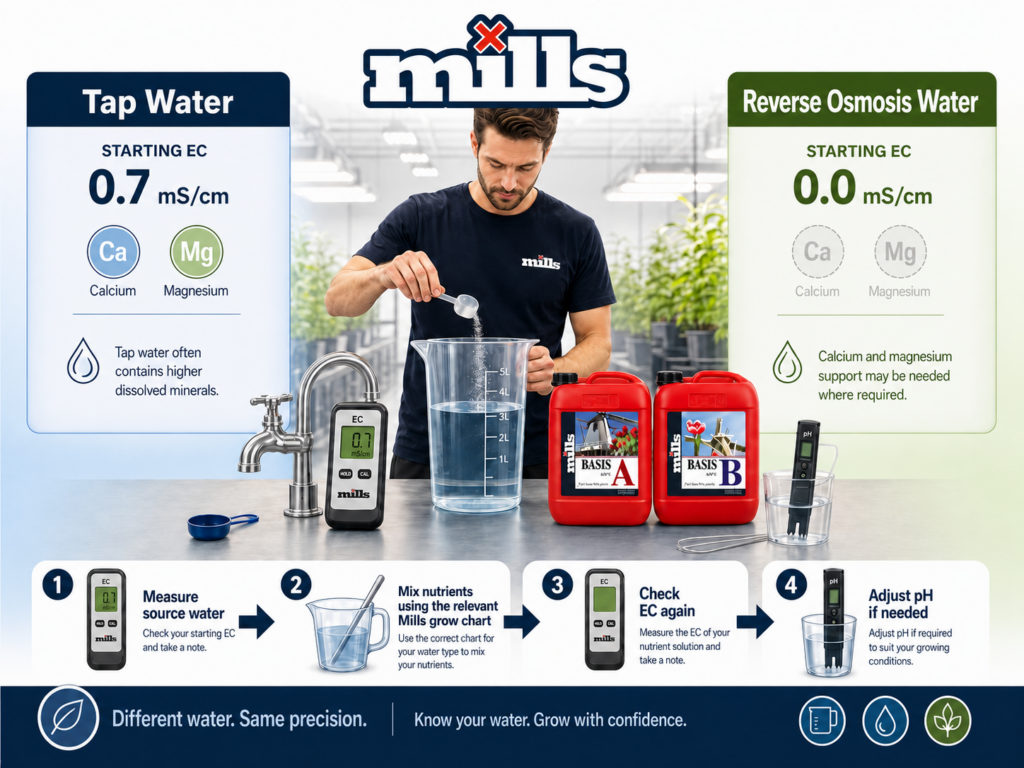
So, if hard water is not automatically a problem, can it be useful? Yes, it already contains minerals, especially calcium and magnesium. All good stuff for your plants. The problem is if growers forget that minerals are already in the water and add nutrients the plant doesn’t need.
Water types will vary depending on the source. Your tap water might already have a higher EC and dissolved minerals before you’ve unscrewed the Basis A&B bottle. Adding feed on top of that might cause the EC to rise faster than expected, and growers might wrongly blame the feed rather than the fact that the water was already loaded.
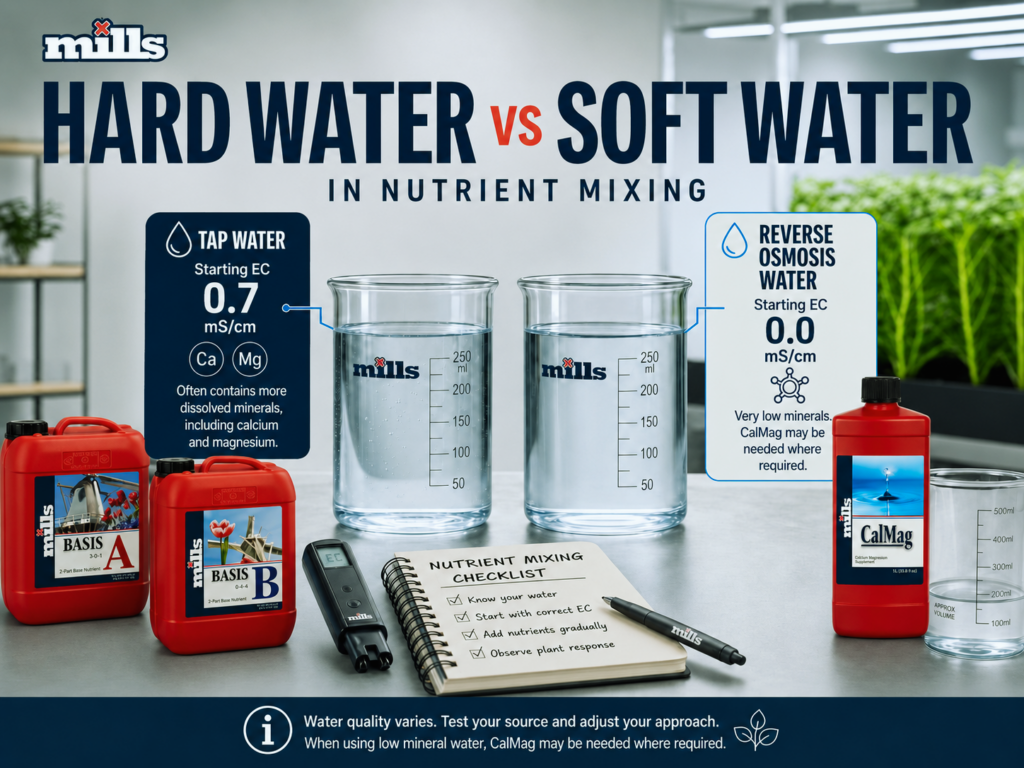
It’s not just the EC that hard water can affect. It can also make pH harder to manage. Some growers find they need more pH adjustment to bring everything into range, and that can get frustrating fast, especially if they are following the feed chart but still seeing numbers that refuse to behave.
Although the problems hard water can cause can get complex, the solution is simple: measure before you mix. Check the EC of your water before mixing, then build your feed from there. Basis A&B is designed to provide complete core nutrition, but your water decides how much space you have left to work with. With hard water, the job is not to panic, or if you do, panic slowly. By measuring before mixing, you establish a baseline before adding more to the tank.
What Soft Water Does to Your Plant Feed
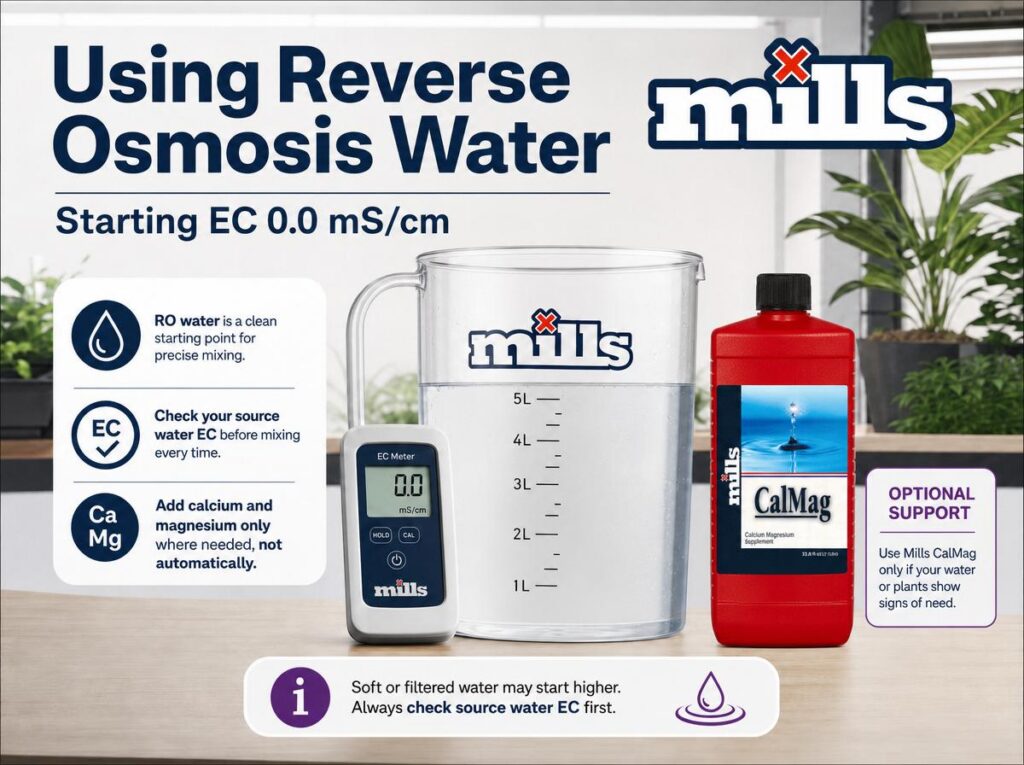
Soft water sounds easier because it starts with fewer minerals. That might sound appealing because you can add as you go. In soft, filtered, or RO water, the mineral content may already be much lower.
This is where the problems can mount up if you don’t account for that. The EC might look ok, the feed chart might make sense, but the crop can still begin to show signs of deficiency if calcium and magnesium are not adequately supported.
Mills CalMag is there for exactly this situation. It helps support soft, filtered, and RO water by adding calcium and magnesium back into the mix where needed. Used properly alongside Basis A&B, it provides the crop with better mineral support and gives growers greater confidence in the crop’s foundation.
With soft water, it’s not about throwing the kitchen sink at the feed because the EC has dipped. Check the water, then build the feed properly from there. That way, you give the plant what it needs when it needs it.
Why EC Matters from the Start
EC is one of those numbers growers can get obsessed with. But before nutrients even enter the mixing bucket, your water already has an EC reading of its own.
That is why the Mills grow chart is split into two starting points. One chart is designed for tap water with an initial EC of 0.7, while the other is for reverse osmosis water with an initial EC of 0.0. The feed schedule stays rooted in the same Mills logic, but the starting water changes how much room there is in the tank before nutrients are added.
If your water starts with a higher EC, and then you add Basis A&B on top without checking the final EC, the final EC can climb faster than a window cleaner up a ladder.
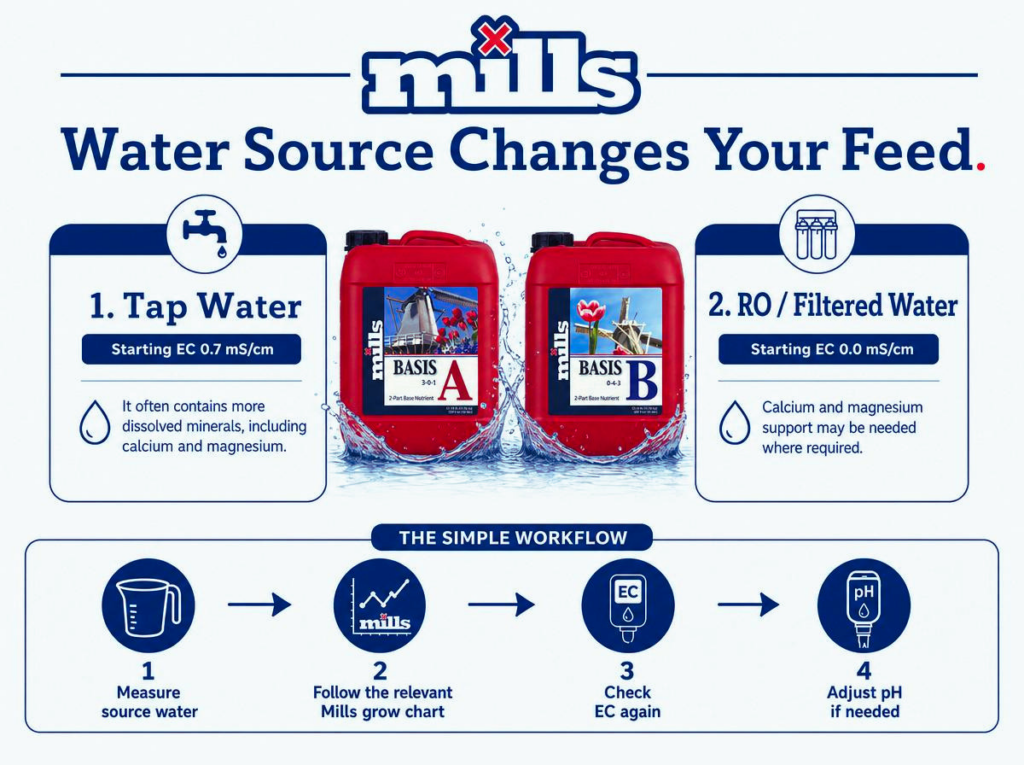
If your water starts with a very low EC, especially with RO or filtered water, there might be more room for feed, but fewer calcium and magnesium minerals than the plant needs. That’s why you can have two growers in different locations following the same feeding chart that get different results. Everything from the chart to the nutrients might be identical, but the water is doing its own thing.
The easiest way to avoid that mess is to check the EC of your water before you add anything. Once you know the starting point, you can make better decisions with Basis A&B, Mills CalMag and any pH adjustment needed. It keeps the feed more controlled and saves you from chasing numbers after the tank has already gone sideways. With EC, the first reading is not the final whistle; it’s a working baseline
Building Your Feed Around the Water
Knowing what type of water you’re working with makes mixing the feed much clearer. By checking the EC first, you can see which minerals your water already contains and which it may be missing. Basis A&B are designed to provide plants with their core nutrition, and CalMag is the additive that provides calcium and magnesium support to the water source where it is needed.
Hard Water vs Soft Water
Hard water and soft water are not enemies. They are different baselines. Once you know what is already in the tank, you can build the feed properly, use CalMag where needed, and keep the crop on track from the first mix.


